AuraBed — Hospital Operations & Bed Management System
Project Title :Real-Time Capacity Command Centre for a 280-Bed Hospital
Business Goal :Eliminate manual bed tracking, reduce ED transfer delays, and give charge nurses real-time ward visibility
Role :UX and UI Designer
Year :2025–26
Tools :Figma, Claude Design
Outcome :
Live bed board across ICU, Cardiac, Med/Surg & Observation wards
AI-powered natural language bed matching — Command Bar
Predictive discharge timeline driven by EHR + RTLS feed
Housekeeping Kanban with automated room-ready notifications
ED Transfer triage with priority queuing and ETA tracking
Doctor schedule and capacity visibility on a single command centre
40%
FASTER
ED Transfer Time Reduced
Bed assignment decisions that previously took 20+ minutes via phone now resolved in under 12 min with live availability data
280
BEDS LIVE
Full Ward Visibility
All 280 beds across 4 ward types visible in real-time — status, isolation flags, telemetry, and cleaning state in one board
68m
AVG TURN
Bed Turnaround Tracked
Discharge-to-clean-to-ready cycle now measured and surfaced — housekeeping queue auto-populated from EHR discharge orders
AI
MATCH
Intelligent Bed Matching
Command Bar lets staff query beds in plain language — isolation, ventilator, step-down — matched by proximity, readiness & acuity
Project Concept
The Problem
Bed status was managed on whiteboards and Excel. Charge nurses had no real-time view of which beds were ready, cleaning, or on hold. ED transfers were delayed by 15–25 minutes because availability was checked via phone calls across wards. Housekeeping was reactive — rooms sat unoccupied between discharge and cleaning notification because there was no automated trigger. No single system connected the ED, ward staff, housekeeping, and bed management into one operational view.
✗
No real-time bed board — staff used paper charts and phone calls; bed status was stale by the time it reached the ED
✗
ED transfer delays — no system to accept or route inbound ambulance cases; charge nurses had to manually locate isolation + ventilator-capable beds
✗
Housekeeping lag — room turnover averaged 90+ minutes; no automated trigger from discharge order to cleaning task assignment
✗
Siloed departments — ED, ward charge nurses, housekeeping, and bed management each worked from separate tools with no shared operational context
What I Designed
A
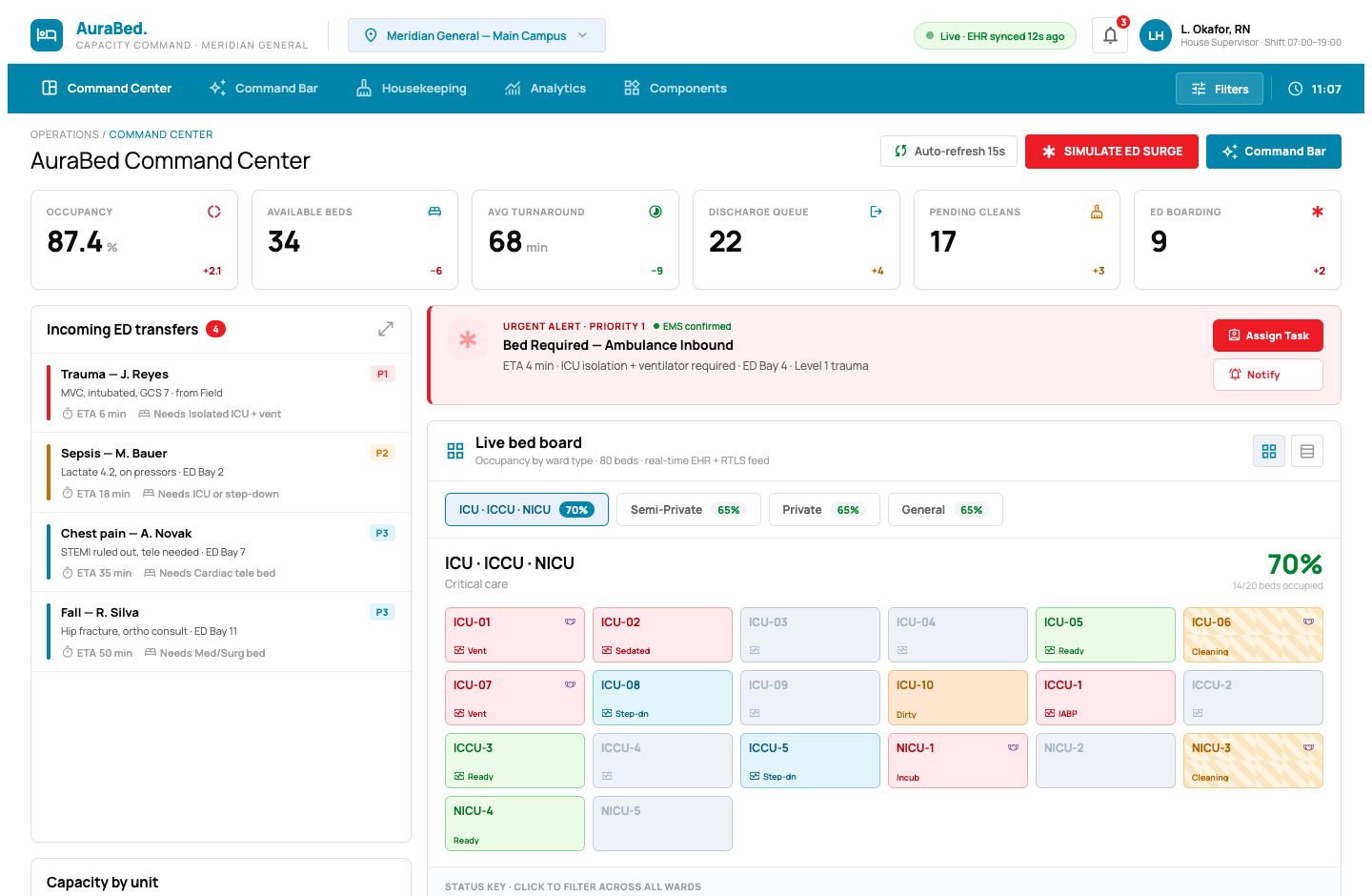
Live Bed Board — Command CentreA real-time grid of all 280 beds across ICU/NICU, Cardiac, Med/Surg, and Observation — colour-coded by status, filterable by isolation, telemetry, and ward. Updates via EHR + RTLS feed.
B
AI Command Bar — Natural Language Bed MatchingStaff can query "ICU isolation + ventilator available now" in plain text. The system scores and ranks matching beds by proximity, readiness, and patient acuity criteria.
C
ED Transfer Triage PanelIncoming ED cases are queued with priority level, ETA, and bed requirement. Charge nurses receive a one-tap assignment flow with urgent alert escalation for Level 1 trauma.
D
Predictive Discharge TimelineEHR signals — lab results, PT clearance, pharmacy — feed a confidence-scored discharge prediction per patient, giving housekeeping a 2–4 hour advance window to prepare.
E
Housekeeping Task BoardDischarge triggers auto-create cleaning tasks assigned to the nearest available housekeeper. Status flows Queued → Active → Inspection → Done, surfaced on the command centre.
Research & Discovery
What the data revealed
Contextual inquiry sessions with charge nurses, ED physicians, and housekeeping supervisors across two hospital sites surfaced four critical operational breakdowns.
ED Wait Extension
68%
of ED patients waited >15 min extra for a bed due to unavailable real-time ward data
Manual Bed Tracking
82%
of charge nurses still used whiteboards or phone calls to check bed availability across wards
Housekeeping Lag
90min
average room turnaround time — 35 min of which was notification delay before cleaning even started
Missed Discharge Windows
54%
of predictable discharges were not actioned within the optimal window, extending bed hold time unnecessarily
01
Charge nurses context-switch constantly
They fielded 12–18 phone calls per shift about bed availability — time that should be spent on patient care. A single visible board would eliminate most of those calls.
02
ED physicians distrust verbal bed confirmations
Beds confirmed over the phone were often already assigned to someone else by the time the patient arrived. Real-time lock-and-assign was non-negotiable.
03
Housekeeping supervisors have no system visibility
They received discharge notifications via radio or verbal handoff — often late. An automated task queue tied to EHR discharge orders would halve their average response time.
04
Isolation and ventilator requirements are the hardest to match
Specialty bed requirements (neg. pressure, telemetry, ventilator) were checked manually against a printed ward list. An AI-assisted query layer was identified as the highest-value feature.
"By the time I get the bed number from the ward, it's already been taken. I need to see what's actually free right now, not what was free 10 minutes ago." — ED Physician, contextual interview
Users & Roles
Who uses AuraBed
Four operational roles drive AuraBed — each with distinct decision-making scope, visibility needs, and system touchpoints across the hospital hierarchy.
Hospital Admin
Oversees hospital-wide occupancy, capacity utilisation, and strategic bed planning. Needs high-level dashboards showing real-time census, turnaround trends, and ward-level KPIs to make policy decisions.
StrategicCensus ViewKPI Reporting
Departmental Head
Manages bed allocation and doctor scheduling within their department. Needs ward-level occupancy, discharge predictions, and physician availability to coordinate daily rounds and admissions planning.
ManagerialWard OversightSchedule View
Operation Executive
Coordinates real-time bed assignments, ED transfer requests, and inter-ward movements. Primary user of the Command Centre — needs live bed board, incoming transfer queue, and urgent alert management.
Primary UserBed AssignmentTransfer Flow
Supervisor
Manages on-ground housekeeping and room turnaround tasks. Needs automated task creation on discharge, team assignment, and real-time status tracking — Queued, Active, Inspection, Done — across all wards.
OperationalTask QueueStatus Tracking
Workflow Design
Before vs. After — ED Transfer Flow
The old flow required 5 manual touchpoints over phone and radio before a bed could be confirmed. The redesigned flow reduces it to 2 system-driven steps with real-time lock.
Before — Manual Process
1
ED nurse calls charge nurse by phoneDescribes patient need verbally — ward, isolation type, ventilator requirement
2
Charge nurse checks paper board or whiteboardWalks to ward board or checks printed list — often 5–8 min delay
3
Bed verbally confirmed over phoneNo system lock — bed may be taken by another assignment before patient arrives
4
Housekeeping notified by radio or verbalOften delayed 20–35 min after discharge order was placed
5
Patient transported — bed sometimes unavailableRe-routing required; patient waits in corridor or ED bay
After — AuraBed System
1
ED raises transfer request in AuraBedSpecifies clinical criteria — system instantly surfaces matching available beds with readiness ETA
2
Charge nurse accepts via one-tap in Command CentreBed is system-locked immediately — no double-assignment risk
3
Housekeeping task auto-created on discharge orderNearest available housekeeper is notified instantly — no radio, no wait
4
Patient transferred with confirmed, ready bedETA, bed number, and ward visible to ED team throughout — zero corridor waits
Design Decisions
Key choices and why
Each decision was driven by field research and the principle that critical clinical tools must have zero ambiguity — information has to be immediately readable under high-stress conditions.
🏥
Colour-coded bed status over text labels
Status was encoded purely in colour (occupied, available, cleaning, isolation, step-down) so charge nurses can read the entire ward at a glance without scanning text — critical for high-pressure decisions.
🔍
Natural language Command Bar for bed matching
Rather than building a complex filter UI that requires multiple interactions, a single text input lets staff query in clinical language. Reduces cognitive load when matching specialty requirements under time pressure.
⚠
Urgent alert as the highest-priority UI element
Priority 1 ambulance inbound events surface as a persistent, red-left-bordered banner above all other widgets — not a notification bell. The action (Assign Task / Notify) is always reachable without modal dismissal.
📋
Predictive discharge confidence scores
Instead of binary discharge flags, each patient shows a probability score (54%–92%) derived from EHR signals. This lets housekeeping pre-schedule and charge nurses plan reassignment hours ahead of actual discharge.
📈
Ward-tab filtering rather than full-page navigation
Charge nurses manage one ward at a time but need to jump quickly. Tab-based ward switching with persistent summary stats eliminates full-page loads and keeps operational context intact between views.
🕐
Doctor schedule in calendar week format
A horizontal time-band calendar (vs. a list) lets charge nurses cross-reference physician availability against expected discharge windows — enabling smarter morning rounds scheduling without separate systems.
Accessibility
Colour coding is always supplemented with icons and text labels — no status relies on colour alone. Font sizes are set for legibility on wall-mounted screens at 2–3 m distance.
Data Latency
All bed statuses display a "last synced" timestamp. Stale data (>60s) triggers a visual warning — clinical staff must always know if the view is live or potentially delayed.
Role-Based Views
The same underlying data is filtered and presented differently for ED physicians (bed matching priority), charge nurses (ward overview), and housekeeping (task queue) — one system, three contexts.
EHR Integration
Discharge orders, isolation flags, lab results, and transport booking data all flow in via EHR API — AuraBed is a read + action layer, not a data entry system, minimising dual-entry errors.
Wireframes
Information architecture & layout exploration
Low-fidelity wireframes validated the core layout hierarchy before committing to visual design. Priority was given to information density and scanability over aesthetics.
Command Centre — Bed Board
AI Command Bar — Bed Matching
Housekeeping Task Board
Predictive Discharge Timeline
Live Prototype
Explore the full UI
The interactive prototype covers all three screens — Command Centre, AI Command Bar, and Housekeeping Board — with live state, filtering, and bed assignment flows.
AuraBed Command Centre
A fully interactive UI prototype built in HTML, CSS, and JavaScript — no static mockup. Explore live bed status, filter by ward, trigger the urgent alert flow, and query the AI Command Bar with real search interactions.
A clinical-grade palette — high contrast, status-safe, and readable at distance. Typography uses Manrope exclusively for density without sacrificing legibility.
Manrope — Primary Typeface
Display / Hero87.4%
Section headingCommand Centre
Widget labelLive Bed Board
Body / metaOccupancy by ward type · 280 beds · real-time EHR